


Do you dream of strolling through Parisian boulevards, exploring the Venetian canals, or savoring Roman pasta? For many U.S. residents, Europe tops the travel bucket list. But if you are living in the United States on a temporary visa — be it an H-1B, L-1, J-1, F-1, or even as a Green Card holder — your journey begins long before you board the flight. Latest data from the Department of Homeland Security reveals 12.8 million green-card holders and 3.6 million people in the US on temporary visas in 2024, with a large percentage seeking travel permits into the Schengen region. While the process can feel like a maze, rest assured that you are not alone! With the right supporting documents you can simplify this challenge and blissfully gear up for your European adventure!
In this blog, we will:
- Look at the document checklist applicable to all U.S. visa holders
- List specific supporting documents for Green Card holders and temporary visa holders
- Deliver expert advice on how to make your Schengen journey the smoothest one yet
Document Checklist For All U.S. Visa Holders
Before delving into visa-specific details, it is important to understand that all Schengen visa applicants, regardless of the type of U.S. visa they hold, must submit a standard set of documents. These include:
- Passport, valid for at least three months beyond the intended date of departure from the Schengen area and containing at least two blank pages.
- Application form, filled and signed.
- Passport-size photographs that meet the most recent biometric requirements.
- Proof of residence in the U.S., such as a lease document, utility bill, or state ID.
- Proof of financial stability, such as bank statements, pay slips, or sponsorship letters.
- Flight itinerary, showing round trip reservations with exact entry and exit dates.
- Proof of accommodation, such as hotel reservations, or an invitation letter from the host.
- Travel insurance, with a coverage of at least €30,000, valid across the Schengen zone.
Supporting Documents by U.S. Visa Type
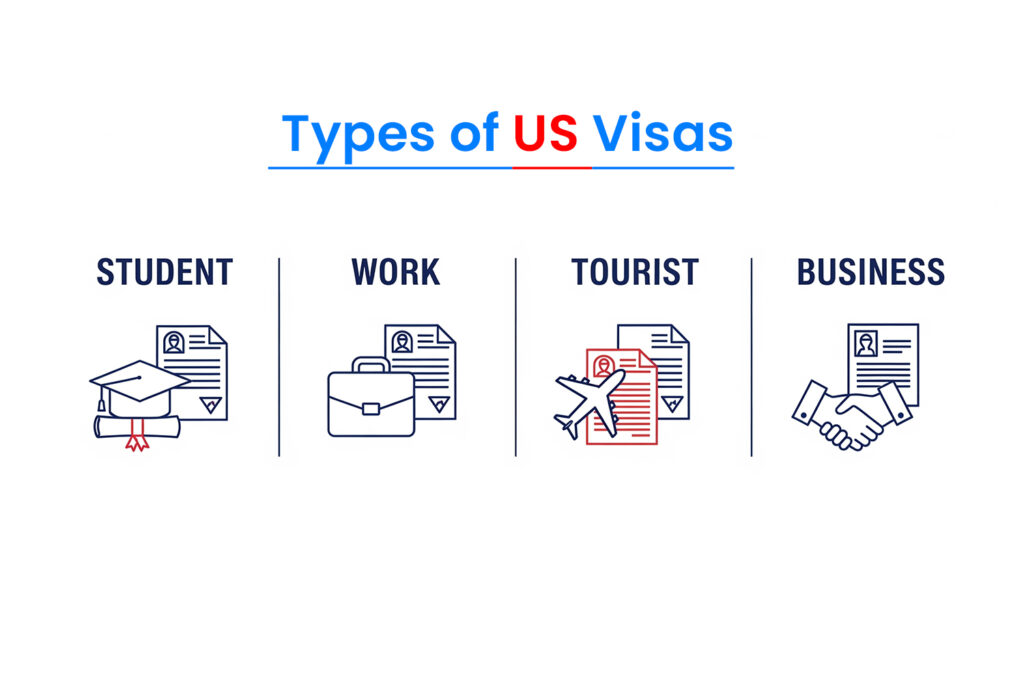
Next, depending upon your specific visa type, there are certain supporting documents that you must furnish besides the ones listed above. These documents are different for each visa type, that is Green Card, H-1B, L-1, J-1, F-1, O, P, and TN.
1. Green Card Holders
Green Card holders have a relatively straightforward application process amongst all temporary visa holders. Their residency status allows them to demonstrate long-term ties to the U.S., reducing concerns about overstaying in Europe. Supporting documents include:
- A copy of the Green Card – front and back.
- Proof of continuous residence in the U.S. such as tax filings or utility bills.
2. H-1B Visa Holders
If you are an H-1B visa holder, proof of valid employment in the U.S. and demonstrating job security is crucial. Supporting documents include:
- Form I-797.
- Employment verification letter from the sponsoring company.
- Pay slips from the last three months.
- Company details such as a business license or letter of incorporation.
3. L-1 Visa Holders
Since L-1 visas involve multinational companies, you must furnish documents that highlight your company’s corporate link between the U.S. and Europe and prove your intra-company transfer status. Required documents include:
- Form I-797.
- Employment letter confirming your role and international transfer.
- Pay stubs and proof of current assignment in the U.S.
- Letter from the company’s European branch confirming the purpose of travel.
4. J-1 Visa Holders
J-1 visa applicants must demonstrate their exchange program affiliation and financial support. Because J-1 visas are temporary, consulates minutely consider whether applicants have sufficient funds and valid reasons to travel to Europe without overstaying. Required documents include:
- Form DS-2019.
- Proof of enrollment or participation in the exchange program.
- Sponsorship letter from the program provider.
- Bank statements if funding is partly self-supported.
5. F-1 Visa Holders
If you are a student studying in the U.S. under the F-1 visa, you must show strong ties to your academic institution. Supporting documents include:
- Form I-20.
- Enrollment verification letter from your university.
- Bank statements or financial aid documents such as a sponsorship letter from your parents or family members. These must be notarized.
- Student ID and proof of residence.
6. Other Temporary Visa Holders – O, P, TN
Applicants under less common visa categories such as artists, athletes, or NAFTA professionals must provide:
- Copy of a valid visa.
- Proof of employment, contract, or program participation in the U.S.
- Financial statements proving adequate means of support.
Practical Tips for Applicants
Submitting a visa application is rarely a “one-day” affair. Checking off the list of documents can take anywhere between a few days to a few weeks. You might have to chase the HR for payment stubs, wait for your university to issue an enrollment verification, or request notarized sponsorship documents from family members. And it all takes time. So, get started on your application at least 6–8 weeks before you actually plan to take the trip.
While working with timelines, also take care that your U.S. and Schengen visas are mutually inclusive. If your F-1 visa is expiring in July, you can’t possibly apply for a Schengen visa that extends into August!
Also keep in mind that while a Schengen visa application has a common standard procedure, each country’s consulate again has its own quirks. For example, Germany requires notarized sponsorship letters, Spain is particular about detailed flight itineraries, and France emphasizes proof of accommodation.
It is also a good idea to maintain two properly organized sets of documents. Some consulates keep copies and return the originals; others return everything. So combing your document stack carefully will keep you prepared and reduce application anxieties. A neatly organized file with labeled sections – passport, application, insurance, bank statements, etc. – makes the visa officer’s job easier and reflects on you as a responsible traveler.
How Schengen Visa Itinerary Can Nullify your Documentation Woes
For non-U.S. citizens living in the U.S., applying for a Schengen visa is more than just submitting a visa application form. Your supporting documents must be perfectly tailored to match your specific U.S. visa type as well. While Green Card holders do enjoy a smooth application process, F-1 students and J-1 exchange visitors are likely to face more scrutiny regarding finances and valid reasons to return to the U.S. Add to this the consulate-specific documentation criteria, and the sea of paperwork can engulf you long before you surf the European waterways. Which is why it is best to leave the documental intricacies to those who know it best.
At Schengen Visa Itinerary, we have your document checklists etched in memory, not to forget the latest, up-to-the-minute information on travel formalities in today’s ever-changing travel dynamics. In the several years of experience that we possess, we have worked with every combination of U.S. visa type and Schengen consulate requirement that has only added to our encyclopedic knowledge. Add to this our state-of-the-art services in creating flight itineraries, booking hotel accommodation, and preparing travel insurance documents, we can fly you through the entire visa application process with professionalism and ease.
Conclusion
One cannot iterate enough the importance of perfect documentation – authentic, attested, doubly verified, and systematically arranged – in securing a Schengen visa. Even a single missing document or a non-compliant, incorrect proof can lead to lost time and wasted money, completely jeopardizing your travel plans.
Schengen Visa Itinerary takes the “what ifs” out of the equation, giving you a neatly bundled European getaway. We know what the consulate needs, and with our precision formulated checklists, we guarantee that your document folders will be in shipshape when you face the consular interview.